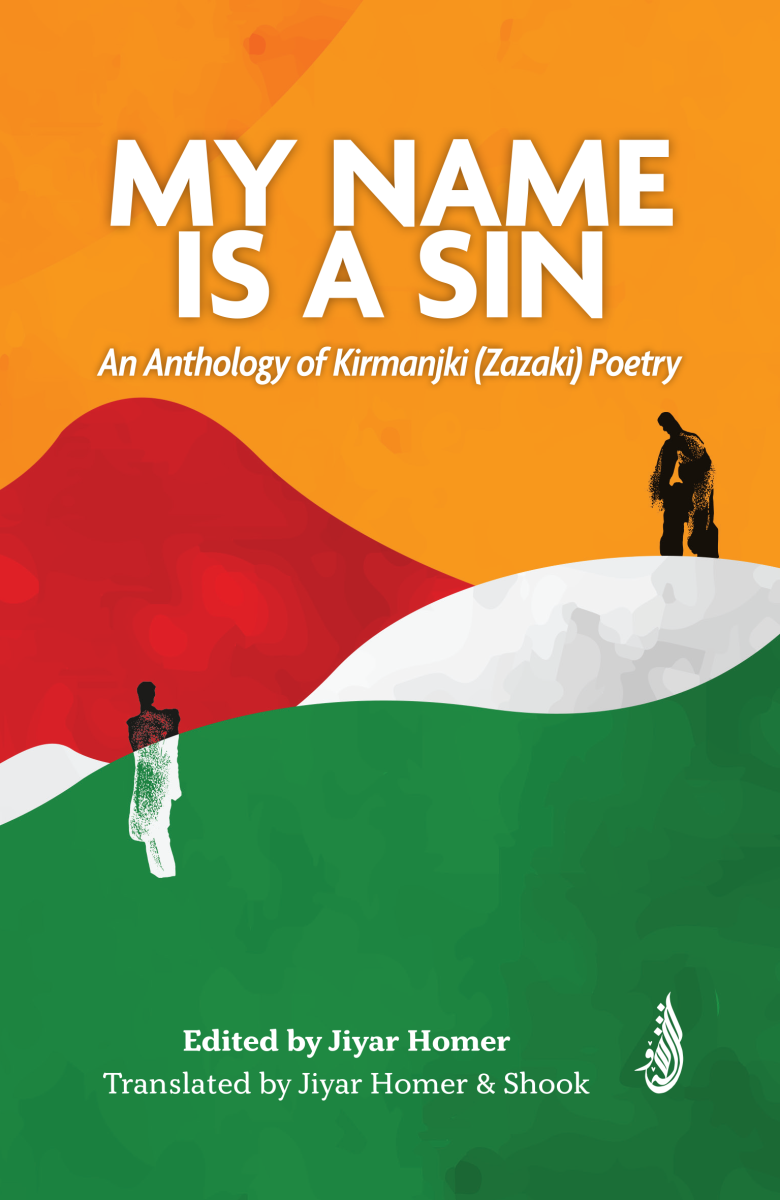
My Name Is a Sin: An Anthology of Kirmanjki (Zazaki) Poetry
My Name Is a Sin: An Anthology of Kirmanjki (Zazaki) Poetry
Edited by Jiyar Homer
Translated by Jiyar Homer and Shook
Proofreading by Oxir Sermîyan
Genre: Poetry
Synopsis:
This anthology, the first ever English-language sampling of Kirmanjki poetry, offers an important introduction to that growing literature. While anthologies are by nature exclusionary, our intentions have not been exclusionary. Rather, we hope to inspire readers’ curiosity to engage further with Kirmanjki literature and its creators, in hopes that work by a greater number of writers will soon reach readers in English, Central Kurdish, Spanish, and beyond. This anthology represents an important milestone in Kashkul Book’s aims and mission, which have since its conception included the publication of translations not just between Kurdish and other languages, but between the rich dialects from across its four regions and diaspora communities, and particularly from those whose traditions have, for various reasons, remained largely unknown beyond their speaker communities. We are honored to support a vibrant nascent tradition like Kirmanjki, particularly in the wake of its centuries of persecution by Ottoman, Turkish, and other regional hegemons, and we are grateful to the poets who have contributed their work to this introductory anthology. As the titular poem to this anthology suggests, publicly speaking Kirmanjki has long been subversive and even outright dangerous. (In Malmîsanij’s own words, “Being a Kurd was banned in Turkey.”) These remarkable poets have not just embraced speaking Kurdish in the face of such persecution, they have boldly committed it to the page, casting their own futures alongside it and staking its rightful place among the literatures of the world. Sere û çimanê mi ser yenî!
Introduction:
An Introduction to Kirmanjki (Zazaki) and Its Literature
Speakers of Kirmanjki Kurdish (commonly known outside its speaker communities as Zazaki) use four distinct names to refer to the dialect, each corresponding to a particular region: Zazaki, Dimilki, Kirdki, and Kirmanjki. Among those terms, the roots “Zaza-” and “Dimil-” come from the names of tribes, and “Kird-” and “Kirmanj-” come from the Kurdish ethonym. We have chosen to follow the standards established by the Vate Working Group, which has been working toward the dialect’s standardization since 1996, and hence will refer to the dialect as “Kirmanjki.” Kirmanjki-speaking Kurds reside in North Kurdistan (inside the present-day nation state of Turkey, their longtime oppressor), primarily in the cities of Amed (Diyarbakır), Çewlîg (Bingöl), Riha (Urfa), Semsûr (Adıyaman), Sêrt (Siirt), Bidlîs (Bitlis), Dêrsim (Tunceli), Mûş (Muş), Erzingan (Erzincan) and Xarpêt (Elazığ). The majority of the population of Çewlig and Dersim speak Kirmanjki, and there are many Kirmanjki speakers in the borders of Amed province. Though lacking definitive statistics, most scholars agree that there are likely at least 3-4 million Kirmanj Kurds, divided across four major accents.
Compared to dialects of Kurdish like Central Kurdish (Sorani) and Northern Kurdish (Kurmanji), whose first writings date to eighteenth and sixteenth centuries, respectively, Kirmanjki remained a purely oral dialect until relatively recently. The first ever Kirmanjki texts to be transcribed to the page were collected by Peter Ivanovich Lerch, and published in St. Petersburg in 1858, along with a Russian-Kirmanjki dictionary he compiled. The texts themselves were gathered directly from Kirmanjs captured by the Russians during the Crimean War. The first Kirmanj Kurd to write down their own dialect was Mela Ehmedê Xasî, who published a Mawlid (a text especially composed for and recited at Prophet Mohammed’s birthday celebration) in Kirmanjki in Amed in 1899. Osman Efendî wrote a second Mawlid in Kirmanjki in 1903, though it was not published until 1933, by Celadet Alî Bedirxan in Damascus. Following those Mawlids, no Kirmanjki texts appeared until 1963, when two texts—a song and a memory from exile—were published in the Istanbul newspaper Roja Newe, whose name means “New Day” in Kirmanjki. Muhemmedê Şêx Ensarî composed several books of Islamic theology in 1947-48, but these were not published until Bîlal Zîlan edited them in 2017. In the 1970s and ’80s, a new generation of newspapers and magazines in North Kurdistan began publishing content in Kirmanjki. These included Özgürlük Yolu, Roja Welat, Devrimci Demokrat Gençlik and Tîrêj, the last of these occupying a special place in the history of Kirmanjki literature. Published half in Kirmanjki and half in Northern Kurdish, Tirêj was the first literary and cultural magazine to emerge from North Kurdistan, and it is no exaggeration to claim that the first examples of contemporary Kirmanjki literature appeared in its pages. The second issue features both the first ever Kirmanjki-dialect poems, two by M. Malmîsanij and two by anonymous poets, and the first ever short story, also by Malmîsanij. Four issues of the magazine were published from 1979 to 1981, the final published in Stockholm because of the military junta that came to power in Turkey in 1980, banning all literary, cultural, and political activities.
In the junta’s wake, most Kurdish intellectuals and politicians fled for Europe, and one of the silver linings to their exile was the advent of Kirmanjki-dialect publishing there, in magazines like Hêvî, Armanc, Berbang, Wan, and Berhem, published from the 1980s until the mid-1990s. By that time, there was significant discussion about the standardization of the Kirmanjki orthography, as variations in spelling between individuals and speakers of the dialect’s multiple sub-dialects sometimes hindered intelligibility. This ultimately led to the first meeting of what would come to be called the Vate Working Group, composed of 15 stakeholders, in Stockholm, in 1996. Following that meeting, at which initial decisions about spelling, certain common terms, and future collaboration were made, the group met again in 1997. At its second meeting, the group decided to publish a magazine to disseminate the proceedings and outcomes of each meeting, as well as original literature. The first issue of Vate was published that August, and as of 2023, 76 issues have followed. To date, the Vate Working Group has convened 36 times in several cities, typically gathering around 20 of the 56 distinct stakeholders to date for 4 to 5 days at a time. The group’s output has been significant, including a Kirmanjki-Turkish dictionary with 61,500 entries and a Turksih-Kirmanjki dictionary with 17,200 entries. Before the establishment of the Vate Working Group, from 1899 to 1996, only 23 books were published in Kirmanjki. Today, there are more than 1,000. The group’s magazine Vate continues to be the most important literary publication in Kirmanjki, publishing 9,821 pages to date, an average of 130 per issue.
Until 1996, there was only one book of Kirmanjki poetry: M. Malmîsanij’s Heraclitus, published in 1988. Today, thanks in no small part to Vate, which has published over 500 poems in its 76 issues, there are more than 60. It is fitting that Heraclitus was the first book of poetry in Kirmanjki, because so often things continue as they begin. Malmisanîj’s work makes clear that poetry is more than just “shouts and cries” or “fire and flames”—it is hard work, deep knowledge, sustained feeling, and liberated imagination. While the delay in writing Kirmanjki has of course had a negative effect on its poetry, it also meant that Kirmanjki poets learned and sometimes contributed to the poetry of other languages and cultures. That knowledge has proven fruitful to the development of Kirmanjki poetry, and as a result most of the poetry being published today displays a mastery of craft and selection of subject matter that belie its relative youth. Kirmanjki poetry is blooming, and its best poets are now recognizable for their style and subject matter. The number of poets publishing second and third collections increases by the day.
This anthology, the first ever English-language sampling of Kirmanjki poetry, offers an important introduction to that growing literature. While anthologies are by nature exclusionary, our intentions have not been exclusionary. Rather, we hope to inspire readers’ curiosity to engage further with Kirmanjki literature and its creators, in hopes that work by a greater number of writers will soon reach readers in English, Central Kurdish, Spanish, and beyond. This anthology represents an important milestone in Kashkul Book’s aims and mission, which have since its conception included the publication of translations not just between Kurdish and other languages, but between the rich dialects from across its four regions and diaspora communities, and particularly from those whose traditions have, for various reasons, remained largely unknown beyond their speaker communities. We are honored to support a vibrant nascent tradition like Kirmanjki, particularly in the wake of its centuries of persecution by Ottoman, Turkish, and other regional hegemons, and we are grateful to the poets who have contributed their work to this introductory anthology. As the titular poem to this anthology suggests, publicly speaking Kirmanjki has long been subversive and even outright dangerous. (In Malmîsanij’s own words, “Being a Kurd was banned in Turkey.”) These remarkable poets have not just embraced speaking Kurdish in the face of such persecution, they have boldly committed it to the page, casting their own futures alongside it and staking its rightful place among the literatures of the world. Sere û çimanê mi ser yenî!