
Kashkul Launches the Ismail Khayat Collection at the University of Exeter
In 2017, Kashkul began working on this collection alongside Ismail Khayat himself. Our work with Kak Ismail emerged out of a deep respect for his work and a deep friendship that grew as we shared the effort of creating this archive as well as his AUIS' hosted retrospective, the AUIS Ismail Khayat Stone Garden, and multiple documentaries about art and artist alike. He very much helped shape his legacy with us. We began with extensive interviews, which we developed into short pieces to accompany the retrospective, then edit into copy for the retrospective booklet, and now accompanies his digital exhibitions. As Kashkul’s artist in residence, Khayat led workshops for students that culminated in the sculpture garden that now, in memorial, bears his name. His prolific vision continues to unfold around us as we celebrate him, his legacy, and his family, who cherish him for all that he was and for all that he remains: a giant in the Kurdish landscape of visual art.
EXETER, UK
May 6, 2026
The Kashkul Art Archive houses collections developed with Kurdish visual artists over years of collaborative projects and extensive, often repeat, artist residencies. Each collection marks the beginning--or the memorializing--of a long, meaningful commitment to building as complete a library of each artist's work as possible through digitizing, interviewing, translating, subtitling, curating, and presenting this work to the public across continents. To bring movement and introduce mutliple media access points for researchers and also the general public to these online libraries, we produce short and feature-length documentaries.
Every collection emanates from a deep, personal connection that we explore with the artist and their work. We work slowly, moving through various mediums and projects in a way that reflects our creative ethos and the artist's intentions, desires, needs, and vision.
The Ismail Khayat Collection
Now available on the Digital Archive of the Middle East (DAME) at the University of Exeter.
In 2017, Kashkul began working on this collection alongside Ismail Khayat himself. Our work with Kak Ismail emerged out of a deep respect for his work and a deep friendship that grew as we shared the effort of creating this archive as well as his AUIS' hosted retrospective, the AUIS Ismail Khayat Stone Garden, and multiple documentaries about art and artist alike. He very much helped shape his legacy with us. We began with extensive interviews, which we developed into short pieces to accompany the retrospective, then edit into copy for the retrospective booklet, and now accompanies his digital exhibitions. As Kashkul’s artist in residence, Khayat led workshops for students that culminated in the sculpture garden that now, in memorial, bears his name. His prolific vision continues to unfold around us as we celebrate him, his legacy, and his family, who cherish him for all that he was and for all that he remains: a giant in the Kurdish landscape of visual art.
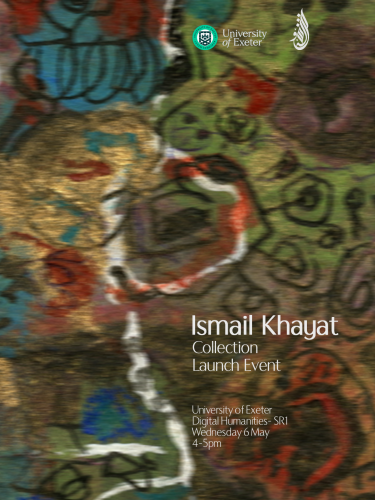
On May 6, 2026, at the launch of the Khayat digital archive with the Digital Archive of the Middle East (DAME) at the University of Exeter, Pshtiwan Babakr introduced the collection and the collaboration, and reflected on the personal history behind the archive. He read from our conversations with Khayat on the many moments and the great effort that shaped Khayat's career and its rich world, from its most basic elements of stone, mud, and land, to the scraps he drew from his surroundings, and the images that appeared to him as distilled scenes of lived moments.
The Stone Man retrospective on the AUIS campus celebrated fifty years of Khayat’s artistic process. Khayat gave us freedom to shape the exhibits within the retrospective. We framed recurring images in his work so that viewers could see the way Khayat examines one idea through multiple manifestations. To guide visitors through Ismail’s various periods, we chose to display the sketches, masks, and paintings that show these progressions of style, placing them in frames, shadow boxes, and within tables specially designed and hand crafted for the materials and the occasion.
The Ismail Khayat Sculpture Garden, named in memorial, grounds Khayat’s worldview on the AUIS campus, displaying the kinds of transformations Khayat inspired. The Kurdistan Botanical Foundation brought greenery to our garden with specimens from all over the Kurdish region, making sure what grows alongside the stones is another form of art. With Khayat, every stone brought to the garden is from a significant landscape of his life, from Khanaqin, his birthplace, from Pirar, the “no man’s land” where his peace project was born and our garden inspired, from Halabja, the city that offered him so much of his poignant imagery, from Slemani, the city where he spent most of his life. Khayat himself painted originally painted the stones with student-artists to teach his methods of seeing stone and paint to the next generation, but also to help the next generation begin to consider and experiment with the impact they’d leave on their environment, to discover how they might want to articulate their own ideas about their world.
Ismail’s Imagination documents Khayat’s reflections on everything that moved through his artistic practice. The many topics captured across hours of filmed conversations in curated frames Pshtiwan tailored, drawing from Khayat’s environment are now edited into short documentaries shaped around the different projects we developed with Khayat. These materials also came together in a longer documentary that traces the threads of his thinking.
In 2025, as the original paint had succumbed to weather, Sufyan Jalal, along with a group of students, took up Khayat's mantel as well as anyone could and renovated the garden, tracing Khayat’s original techniques while drawing from Ismail's artwork vibrant, iconic figures they then also brought to the stones. Brought from Khayat’s world, brushed by Sufyan and his students, the stones present a vision both familiar and refreshed, alluding to the right philosophy of seeing that Ismail was always so ready to discuss.
This collection includes the outstanding paintings we have seen in exhibitions, along with many works that have not yet entered gallery spaces but remain an integral part of an artist’s process: his sketches, notebooks, personal archives, and collaborations with other artists.
"You know, a hand—you can read it. You can see someone’s hands as an outline—that you fill with imagination. What fills our hands—this is what’s important. Once, for a certain period, I painted bodies without heads. In another period, I painted only the hands. Each part of the human body is a vital source. The right eye is different from the left. All that difference is precious. You have to look from many distances, from many sites, to see properly. You have to want to see."
Hands, from The Stone Man booklet, 2018.
Explore the Collection at Digital Archive of the Middle East (DAME) website.
For feedback or inquiries, please contact the team at [email protected].